AI & Machine Learning Internship in Pune: Complete Guide for Students in 2026
Introduction
How can a student transform AI/ML knowledge that comes from lectures, YouTube videos, and online courses into something that a resume can truly display?
That is the question that most BCA, MCA, BSc, and engineering students eventually face. You may understand what a neural network is or how logistic regression works. You still freeze when a person asks, "Show me a project you have built." Theory explains the ideas. It seldom shows you how to clean a messy dataset, fix a model that will not converge, or describe your work to a mentor in simple words.
This is where an AI/ML internship in Pune comes into play. Pune has become one of India's centers for software development, IT services, and technology startups. It offers a setting for students to experience real project work, receive structured mentorship, and work in a professional environment — all without moving to a metro-only tech city.
This guide is meant for students and freshers who want to understand how AI/ML internships truly work. It covers who can apply, which skills are important, what a normal learning path looks like, which projects are worth building, and how to judge an internship before you agree to it. Along the way, we will also see where a Pune-based training and internship provider such as Maxgen Technologies fits into this picture, using information about the internship areas it offers.
By the end of this article, you will have a realistic roadmap — starting from Python basics to a portfolio-ready GitHub profile — for approaching an AI/ML internship in Pune in 2026.
What Is an AI and Machine Learning Internship?
Artificial Intelligence (AI) is the field that deals with creating systems capable of doing tasks that usually need human thinking. These tasks include reasoning, spotting patterns, understanding language, and making decisions.
Machine Learning (ML) is a part of Artificial Intelligence (AI) that concentrates on developing algorithms that can learn patterns from data without being written with fixed rules.
An AI/ML internship is an organized learning journey where a student uses concepts such as Python programming, data analysis, machine learning algorithms, and model development on real or realistic projects. Usually, a mentor guides the student. The student is mainly expected to write code, manage data, and solve problems independently. The internship lies between classroom learning and full industry work.
Internships usually also involve:
- Practical, hands-on learning instead of just lectures
- Project-based work that uses datasets and problem statements
- A mentor who has hands-on experience with Machine Learning (ML)
- Exposure to industry tools, workflows, and expectations
- Portfolio building that includes code, documentation, and results you can show later
Course vs Training vs Internship
Students often use these three terms interchangeably, but they serve different purposes.
| Aspect | Course | Training | Internship |
|---|---|---|---|
| Primary goal | Teach concepts and theory | Build specific technical skills | Apply skills to real/realistic projects |
| Format | Videos, lectures, assignments | Structured sessions, exercises | Ongoing project work with mentorship |
| Output | Conceptual understanding | Skill proficiency | Portfolio, project experience, certificate |
| Guidance level | Often self-paced | Instructor-led | Mentor-guided, more independent work |
| Best for | Building foundational knowledge | Strengthening specific tools/skills | Demonstrating applied, real-world capability |
A course teaches you what linear regression is. Training helps you implement it correctly. An internship asks you to use it to solve an actual problem, document your approach, and explain your decisions — which is much closer to what a real ML role expects.
Why Choose an AI/ML Internship in Pune in 2026?
Pune has become an IT and software development hub in India, standing alongside cities such as Bengaluru and Hyderabad. Pune hosts a mix of well-known IT services firms, product startups, and a large student crowd from its engineering, computer science, and management colleges.
That combination matters for interns for a reason:
- A dense IT ecosystem. Pune is home to software development, product, and IT services companies, which keeps a steady demand for interns and entry-level talent in web development, data, and AI-related roles.
- A large student base. With BCA, MCA, BE/BTech, and MSc programmes in the area, Pune naturally offers a steady supply of structured internship programmes for students.
- Practical, on-ground exposure. Living in a city with a tech industry means interns can do in-person or hybrid internships, meet mentors face-to-face, and build local professional networks.
- Diverse technology exposure. Beyond AI/ML, Pune's IT ecosystem covers web development, mobile app development, cloud/AWS work, and cybersecurity, which is useful for students who wish to explore adjacent skills alongside ML.
- Networking opportunities. Working alongside interns, mentors, and technical staff creates connections that later help interns with referrals, recommendations, or reapplying for full-time roles.
None of this guarantees a salary or job outcome, as that depends on each intern's own skill development and the specific opportunity. The surrounding ecosystem makes Pune a practical, active market for interns to search in.
Why Practical AI/ML Experience Matters for Students
There's a gap between what students learn in school and what they need to do in the real world. Most people don't see this difference until they try to build something from start to finish on their own.
Academic learning usually focuses on:
- Definitions and theory — like what overfitting means or how a decision tree works
- Ready-to-use datasets that come with assignments
- Step-by-step tasks that have a clear right answer
But real-world experience demands much more. It includes things like:
- Coding. Writing code that actually works and is easy for others to read, not just filling in parts of a notebook
- Working with data. Finding data sources, cleaning it up, and understanding messy real-life datasets
- Building models. Picking the algorithm and tweaking it to fit the actual problem
- Debugging. Tracking down why a model fails to train, why accuracy numbers don't make sense, or why code crashes
- Testing. Making sure the model works reliably on data it hasn't seen before
- Documenting. Writing clear comments, notes, and reports so others, or even your future self, can follow your work
- Using Git and GitHub. Keeping track of changes, committing code, and managing a history of your project
- Presenting your work. Explaining your methods, results, and challenges to people who might not know the technical details
- Solving problems. Dealing with unclear goals or incomplete instructions instead of following a strict script
An internship is where all of these skills get practiced over and over. That's why saying "I built X" in an interview carries more weight than saying "I studied X."
Who Can Apply for an AI/ML Internship in Pune?
AI internships in Pune are usually available to people from different fields of study. The main thing they look for is the desire to learn Python, statistics, and machine learning ideas. It's not about having a specific kind of degree.
AI Internship for BCA Students
BCA students usually have some experience with programming and databases. That's a start. A real plan should include:
- Improve your understanding of Python basics (data types, loops, functions, and object-oriented programming basics)
- Study basic statistics and probability
- Get used to using NumPy and Pandas for working with data
- Learn the ideas of machine learning using scikit-learn
Project ideas: predicting student performance, simple spam filters, basic sentiment analysis on product reviews
AI Internship for MCA Students
MCA students usually have a better background in programming and computer science. That means internships can focus more on applied work.
- Make sure you know Python, SQL, and data structures well
- Move quickly into machine learning algorithms and checking how well models work
- Take on projects, from getting data to putting it into use
Project ideas: predicting customer churn, building recommendation systems, making simple fraud detection tools
AI Internship for BSc Students
BSc students who study computer science, statistics, or similar fields usually have strong math skills. That helps a lot in machine learning.
- Use your skills in statistics and probability early
- Learn Python as a tool if you're not already familiar with it
- Understand why algorithms work, not just how to use a library
Project ideas: exploring data, making predictions with regression, doing basic classification work
AI Internship for BE/BTech Students
Engineering students, especially those in computer science, IT, or electronics, usually have some experience with programming and solving problems through schoolwork and projects.
- Use your knowledge of programming to work with Python and machine learning libraries
- Use an engineering-style approach to solving problems when building machine learning systems
- Think about projects that match your area of study (like combining signal processing and machine learning for ECE students or computer vision for those interested in image systems)
AI Internship for Computer Science Students
Computer science students usually find it easiest to move into machine learning internships. Their knowledge of data structures, algorithms, and programming directly helps with machine learning.
- Focus the internship on machine learning topics (algorithms, how to measure performance, basics of learning) instead of basic programming
- Use your coding skills to make better and more efficient systems
- Try out special areas like natural language processing, computer vision, or tools that create content
AI Internship for Freshers
If you're a fresher and don't have a strong project background yet, the best way to start is:
- Learn Python and basic statistics before applying, if you haven't already
- Make one or two small projects on your own before the internship so you're not starting from nothing
- Tell the company about your current skills — most internships expect freshers to learn as they go
- Focus on being steady during the internship: showing up, asking questions, and keeping track of what you learn
Eligibility Criteria for an AI and Machine Learning Internship
Basic Eligibility
Generally, AI/ML internships are open to:
- Students (BCA, MCA, BSc, BE, BTech, MSc, or related fields)
- Final-year students
- Graduates and freshers
- Anyone with basic programming exposure and genuine interest in AI/ML
Recommended Skills (Not Always Mandatory But Helpful)
- Basic programming knowledge, ideally in Python
- Comfort with fundamental mathematics and statistics
- Logical reasoning and problem-solving ability
- Basic familiarity with handling data spreadsheets and simple datasets
- Genuine interest in AI/ML rather than only in the certificate
Skills Required for an AI/ML Internship
Python
Python is the language used for AI and ML work because it has easy-to-read code and a lot of tools for data science and machine learning. Every internship, lesson, and real-world ML project expects you to know Python, which is why it is usually the first thing students learn.
Statistics
You don't have to have a math degree. Knowing some math and statistics helps you understand ML much better:
- Mean, median, mode. Understanding the center of data
- Probability. The basis for many ML methods, especially for classification
- Correlation. Understanding how variables relate to each other
- Basic statistics. Standard deviation, how data is spread out, and basic hypothesis tests
NumPy and Pandas
NumPy helps with fast number calculations using arrays, which is the base for most data science work in Python. Pandas builds on that to give you DataFrames — a way to clean, filter, change, and look at data in tables. Together, they are the tools for preparing data in almost every ML project.
SQL
Most real-world data is stored in databases, not in files like CSV. Knowing SQL — how to select, filter, combine, and aggregate data — is a useful skill that internships and companies expect, even in ML jobs.
Scikit-learn
Scikit-learn is the Python tool for traditional machine learning, not deep learning. It has implementations of methods like regression, classification, and clustering, plus tools for checking how well models work. It is the place to start when you want to do hands-on ML work.
TensorFlow and PyTorch
These are the two tools for deep learning. TensorFlow is made by Google, and PyTorch is made by Meta. Both let you build and train networks. Most internships don't ask for knowledge of these right away, but knowing the basics — like making a simple neural network and understanding how it learns — is a good next step after traditional ML.
Machine Learning Algorithms
AI and ML internships expect you to know these common methods:
- Linear Regression. Predicting numbers
- Logistic Regression. Separating into two groups
- Decision Trees. Making choices based on rules
- Random Forest. Using many decision trees for better results
- K-Nearest Neighbors (KNN). Classifying based on how close things are
- Clustering. Grouping similar data without labels
- Basic ways to check how well models work. Accuracy, precision, recall, F1-score, and a confusion matrix
Deep Learning
Deep learning uses layers of neural networks to find complex patterns, especially for images, sound, and text. Interns usually start by learning about networks (layers, weights, activation functions) and then move into Convolutional Neural Networks (CNNs), which are used a lot for images.
NLP (Natural Language Processing)
NLP is about helping machines understand language. Internships often start with things like text preparation (cleaning and splitting text) and checking if text is positive, negative, or neutral. These are starting points before moving to more complex language tasks.
Computer Vision
Computer vision is about helping machines see and understand images. Topics for beginners include image classification (giving labels to images) and learning about object detection (finding and locating things in images).
Generative AI
Generative AI has become a key topic going into 2026. For students, this usually means:
- Understanding Large Language Models (LLMs) — what they are and how they create text
- Learning how to write inputs (prompts) to get useful answers from LLMs
- Using AI tools that are built on top of existing models and APIs
- Knowing the basics of RAG (Retrieval-Augmented Generation) — using LLMs with other data sources for better answers
- Being aware of responsible AI — knowing about bias, data safety, and what AI can and cannot do
This doesn't have to be something you learn in depth right away. Even knowing the basics and doing a small project is a good step for someone starting in 2026.
What Do You Learn During a Machine Learning Internship?
A typical ML internship goes through these steps:
- Python fundamentals — Making sure you know the syntax, functions, and libraries you will use during the internship
- Data collection — Finding datasets from public places, APIs, or files that are given to you
- Data cleaning — Dealing with missing information, repeated entries, and messy formatting
- Data preprocessing — Changing categorical data into numbers, scaling numerical data, and splitting data into training and test sets
- Exploratory Data Analysis (EDA) — Looking at the data to see patterns, spread, and relationships before building models
- Data visualization — Using tools like Matplotlib to make charts and graphs that help you understand the data better
- Feature engineering — Making new variables or changing existing ones to make models work better
- Machine learning algorithms — Picking the right algorithms for the type of problem you are trying to solve
- Model training — Teaching the algorithm with the training data
- Model evaluation — Checking how well the model works on new data using the right measures
- Model improvement — Adjusting settings, fixing problems like overfitting or underfitting, and trying new ideas
- Basic deployment — Learning how to make a trained model available using a simple script or API, even in a basic way
- Documentation — Writing clear notes that explain your choices, your code, and your results
- Git/GitHub — Saving your work often and keeping track of changes in your project
- Project presentation — Telling others about the goal of the project, how you did it, and what you found
Each of these steps teaches a specific skill, and together they give you the real experience of how machine learning works. This experience is what makes internship graduates different from people who learn on their own.
AI/ML Internship Projects Students Can Build
Below are project ideas commonly used in AI/ML internships, along with what each one teaches.
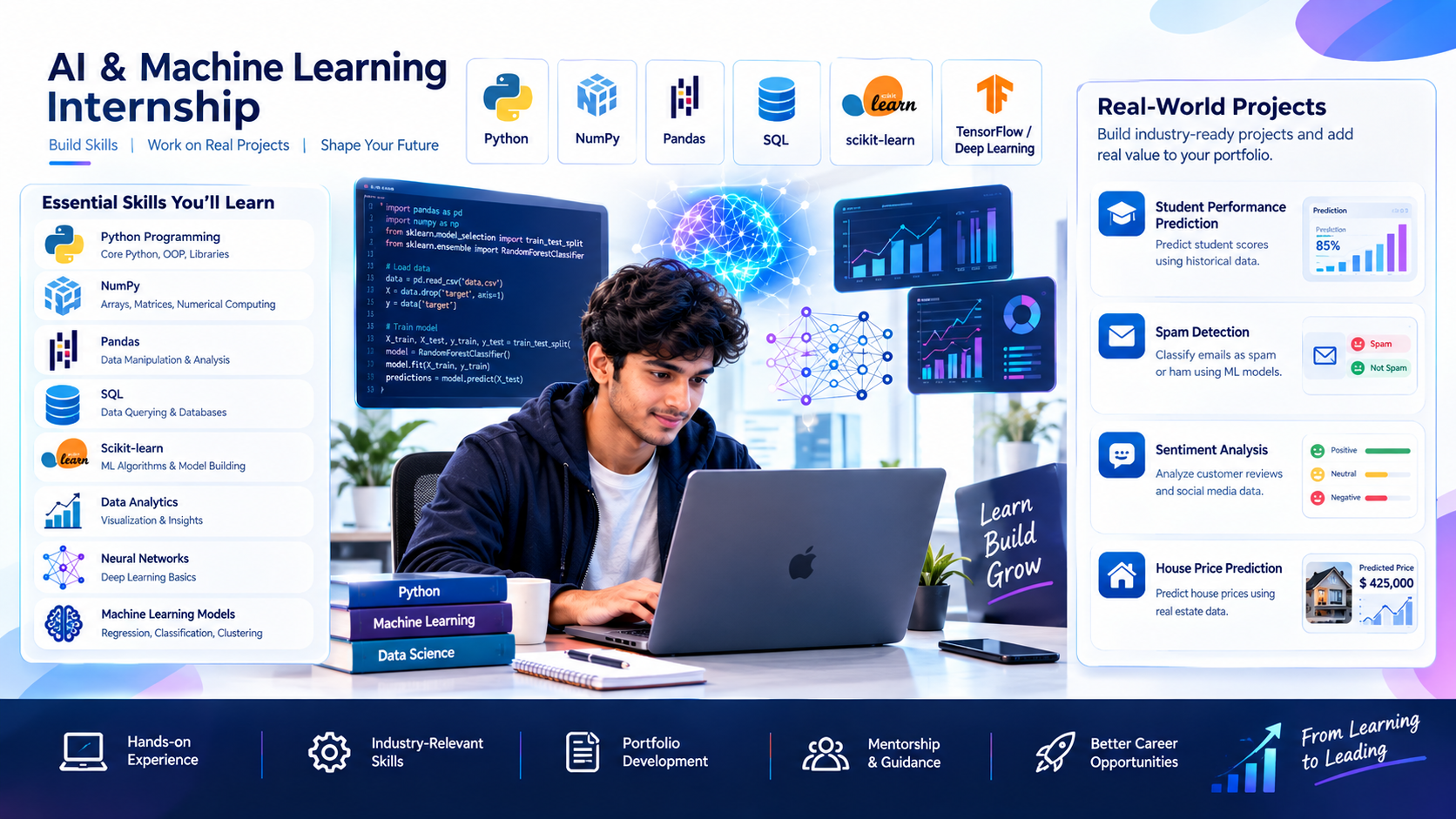
- Student Performance Prediction — Objective: Predict academic outcomes based on study habits, attendance, and prior scores. Technologies: Python, Pandas, scikit-learn regression algorithms. What you learn: Data cleaning, feature selection, regression modeling. Portfolio value: Simple, relatable — shows the ML pipeline clearly.
- House Price Prediction — Objective: Predict property prices based on features like location, size, and amenities. Technologies: Python, Pandas, scikit-learn regression models. What you learn: Handling feature types, regression evaluation metrics. Portfolio value: Demonstrates solid regression fundamentals.
- Customer Churn Prediction — Objective: Predict which customers are likely to stop using a service. Technologies: Python, Pandas, scikit-learn classification algorithms. What you learn: Working with datasets, classification metrics. Portfolio value: Relevant to business use cases that employers notice.
- Sentiment Analysis — Objective: Classify text (e.g., reviews or tweets) as positive, negative, or neutral. Technologies: Python NLP libraries, text preprocessing tools. What you learn: Text cleaning, tokenization, NLP classification. Portfolio value: Introduces NLP as a relevant skill area.
- Spam Detection — Objective: Classify emails as spam or not spam. Technologies: Python, scikit-learn, NLP basics. What you learn: Text feature extraction, classification. Portfolio value: A well-understood, beginner-friendly classification problem.
- Recommendation System — Objective: Recommend products, movies, or content based on user behavior. Technologies: Python, Pandas, collaborative or content-based filtering approaches. What you learn: Similarity metrics, working with user-item interaction data. Portfolio value: An impressive project that maps to real products like e-commerce or streaming platforms.
- Image Classification — Objective: Classify images (e.g., cats vs. dogs, or digit recognition). Technologies: Python, PyTorch, CNN basics. What you learn: Introductory deep learning and computer vision. Portfolio value: Demonstrates ability to work beyond tabular data.
- Sales Forecasting — Objective: Predict sales based on historical data. Technologies: Python, Pandas, time-series/regression techniques. What you learn: Time-based data handling, trend analysis. Portfolio value: Demonstrates business forecasting skills.
- Fraud Detection — Objective: Identify fraudulent transactions. Technologies: Python, scikit-learn classification algorithms, imbalanced data handling. What you learn: Working with rare event classification, precision-recall trade-offs. Portfolio value: Shows understanding of a nuanced, high-stakes classification problem.
- AI Chatbot — Objective: Build a rule-based or ML/LLM-assisted chatbot. Technologies: Python, NLP basics, optionally an LLM API. What you learn: Flow logic, basic NLP or prompt engineering. Portfolio value: Easy to demo, which stands out in interviews.
- Resume Screening — Objective: Classify/score resumes based on relevant skill keywords. Technologies: Python, NLP text matching or classification techniques. What you learn: Text processing, a real-world HR-tech use case. Portfolio value: Applicable to a widely understood business problem.
- Generative AI Application — Objective: Build an application using an LLM API (e.g., a summarizer or Q&A tool). Technologies: Python, an LLM API, prompt engineering, optionally simple RAG. What you learn: Working with generative AI tools, not just traditional ML. Portfolio value: Highly relevant for 2026 job searches, given rising demand for Gen AI familiarity.
Why Live Projects Matter in an AI/ML Internship
Working on a machine learning live project internship — one based on real or realistic business problems rather than textbook exercises — exposes students to challenges that clean, tutorial-style datasets simply don't have:
- Real-world problem solving — ambiguous requirements instead of a clearly defined assignment
- Data issues — missing values, inconsistent formats, duplicate or noisy entries
- Debugging — working through errors and unexpected model behavior independently
- Model evaluation — deciding which metrics actually matter for the specific problem
- Documentation — writing clear explanations for mentors, teammates, or future readers of the code
- Team collaboration — coordinating with other interns or team members
- Version control — using Git to track changes and avoid losing work
- Project presentation — communicating technical work to people who may not be deeply technical
This is also where students build the specific stories they'll later use in interviews — "here's a problem I ran into and how I solved it" is far more convincing than a list of tools on a resume.
AI Internship With Certificate in Pune — Is It Useful?
An internship certificate is a document that confirms you finished a set internship period with a company. It usually includes the area of work, like Machine Learning, and how long you were there. It does have value — it's important to know what it really means, and what it doesn't mean.
What the certificate shows:
- That you took part in a formal internship program
- A credential you can include on your resume and LinkedIn
- Some proof that you stayed consistent and committed over time
What the certificate does not show by itself:
- How skilled you are; that's better shown through your actual projects and GitHub activity
- A promise or guarantee of getting a job
- Proof of specific technical abilities unless you also provide proof from your work
Why real work still matters more: A certificate just says you were there. What matters more is your GitHub repository, your project descriptions, and your ability to talk about your work during an interview. The best way to use the certificate is as a supporting document. List it on your resume alongside the projects, tools, and results you worked on during the internship, and be ready to explain your code and the decisions you made if someone asks.
If you're looking at a certificate from Maxgen Technologies or any other company, it's a good idea to ask what the certificate actually includes — the domain, the length of time, and the scope of the work — instead of just assuming.
AI/ML Internship vs Data Science Internship
| Factor | AI/ML Internship | Data Science Internship |
|---|---|---|
| Main focus | Building and applying learning algorithms and models | Extracting insights and value from data |
| Programming | Python, ML libraries (Scikit-learn, TensorFlow/PyTorch) | Python/R, SQL, data manipulation libraries |
| Statistics | Important, especially for model behavior and evaluation | Central — statistics drives most analysis |
| Data analysis | Present, but often a step toward model building | Core activity — EDA, reporting, visualization |
| Machine learning | Core focus of the internship | Often included as one tool among several |
| Deep learning | Frequently introduced, especially for vision/NLP tasks | Less central, may not be covered in depth |
| Projects | Predictive models, classifiers, occasionally deep learning tasks | Dashboards, reports, business insight projects, some predictive modeling |
| Tools | Scikit-learn, TensorFlow, PyTorch, Pandas, NumPy | SQL, Pandas, visualization tools (Matplotlib, BI tools), sometimes Scikit-learn |
| Career paths | ML Engineer, AI Developer, Deep Learning roles | Data Analyst, Data Scientist, Business Intelligence roles |
Which path to choose: Students who enjoy building predictive systems, working with algorithms, and eventually want to specialize in modeling (including deep learning or generative AI) tend to prefer the AI/ML track. Students who enjoy interpreting data, generating business insights, and communicating findings tend to prefer the Data Science track — though in practice, the two overlap significantly, and many internships (including general ML/Data Science programs) cover a mix of both.
AI vs Machine Learning vs Deep Learning vs Generative AI
| Technology | Simple Meaning | Common Applications | Beginner Level |
|---|---|---|---|
| Artificial Intelligence (AI) | The broad field of building systems that mimic human-like reasoning and decision-making | Virtual assistants, recommendation engines, automation | Start here conceptually |
| Machine Learning (ML) | Algorithms that learn patterns from data instead of being explicitly programmed | Predictive models, spam filters, fraud detection | Beginner-friendly entry point |
| Deep Learning | ML using layered neural networks to model complex patterns | Image recognition, speech recognition, advanced NLP | Intermediate |
| Generative AI | AI systems (often built on large language models) that generate new text, images, or content | Chatbots, content generation, code assistance, summarization | Beginner-to-intermediate for usage; advanced for building from scratch |
In simple terms: AI is the umbrella field. Machine learning is how many AI systems actually learn. Deep learning is a more powerful (and more data/compute-hungry) form of machine learning. Generative AI is a category of AI applications — often powered by deep learning and large language models — focused specifically on creating new content rather than only classifying or predicting.
AI/ML Career Opportunities After Internship
An internship can help students gain relevant experience for career paths such as:
- AI Engineer — building and integrating AI-driven systems
- Machine Learning Engineer — designing, training, and deploying ML models
- Data Scientist — combining statistics, ML, and business context to generate insights
- Data Analyst — analyzing data to support business decisions
- AI Developer — building applications that use AI/ML components
- ML Developer — implementing and maintaining machine learning systems
- Computer Vision Engineer — specializing in image and video-based AI systems
- NLP Engineer — specializing in language-based AI applications
- Generative AI Developer — building applications on top of large language models and generative systems
It's worth being direct here: an internship can help students gain relevant, resume-worthy experience for these career paths — it does not, by itself, guarantee a specific job, salary, or offer. Outcomes depend on the depth of skills built, the quality of projects completed, and how well a candidate performs in subsequent interviews.
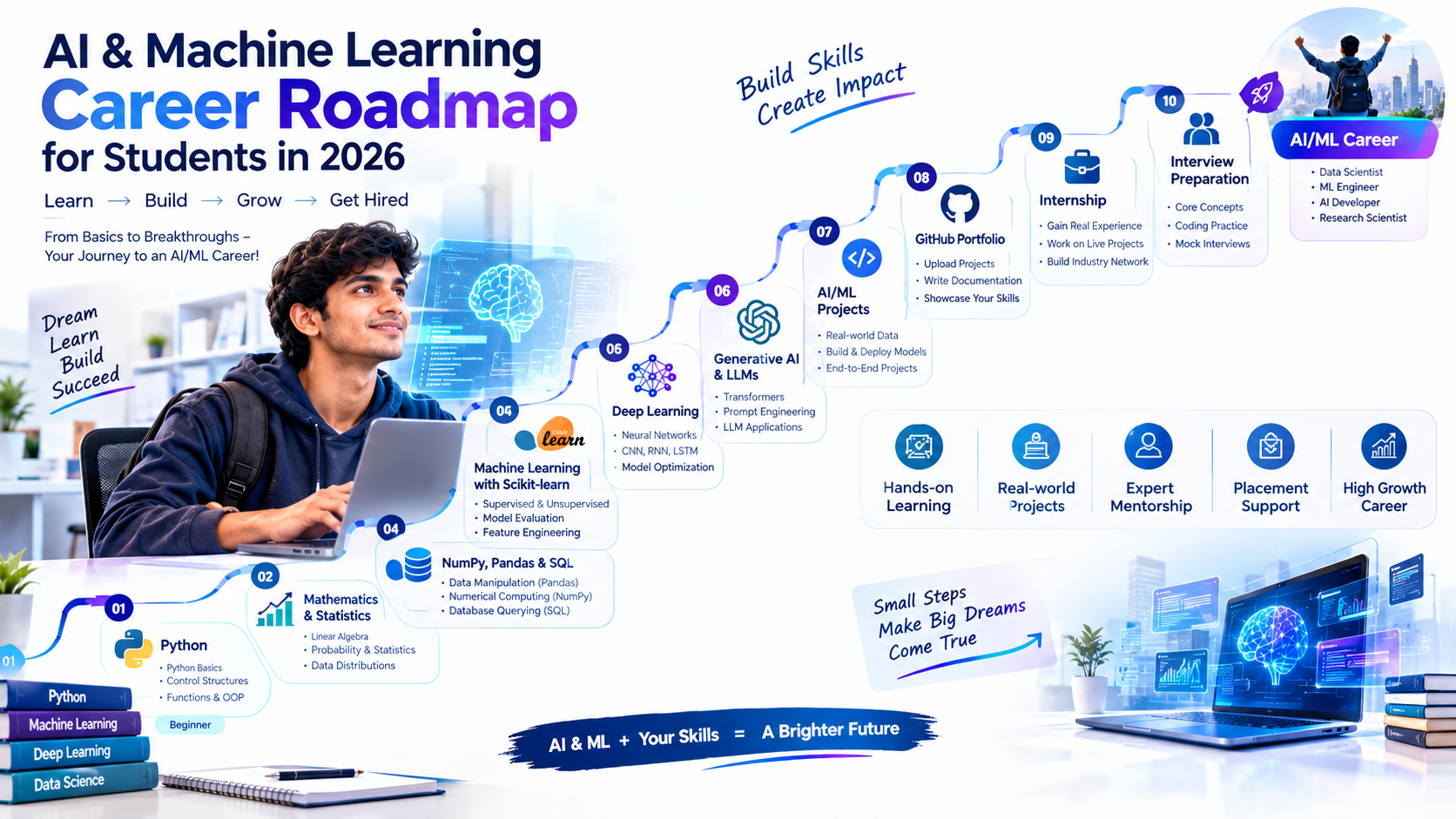
AI/ML Career Roadmap for Students in 2026
A practical, sequential roadmap looks like this:
↓
Python
↓
Mathematics & Statistics
↓
Data Handling (NumPy, Pandas, SQL)
↓
Machine Learning (Scikit-learn, core algorithms)
↓
Deep Learning (Neural Networks, CNNs, TensorFlow/PyTorch)
↓
Generative AI (LLMs, prompt engineering, responsible AI)
↓
Projects (2-3 well-documented, varied projects)
↓
GitHub Portfolio
↓
Internship (applied, mentor-guided experience)
↓
Interview Preparation
↓
AI/ML Career
- Beginner → Python: Start with programming fundamentals; this is non-negotiable for AI/ML work.
- Mathematics & Statistics: Build the conceptual foundation that makes ML algorithms understandable rather than magic.
- Data Handling: Learn to work with real data using NumPy, Pandas, and basic SQL.
- Machine Learning: Move into core algorithms and model evaluation using Scikit-learn.
- Deep Learning: Add neural network fundamentals once traditional ML is comfortable.
- Generative AI: Build at least a conceptual and light practical understanding, given its growing relevance in 2026.
- Projects: Apply everything learned so far to a small set of well-documented projects.
- GitHub Portfolio: Organize your projects publicly so they're easy to share and review.
- Internship: Apply your skills in a guided, real-world setting — this is where most practical learning happens.
- Interview Preparation: Review fundamentals, practice explaining your projects, and brush up on basic coding questions.
- AI/ML Career: Apply for relevant roles, using your internship experience and portfolio as core evidence of your capability.
This roadmap isn't strictly linear for everyone — some students will loop back to strengthen math or Python while already working on projects — but it reflects a realistic, achievable sequence for most beginners.
Why Consider Maxgen Technologies for an AI/ML Internship in Pune?
Maxgen Technologies Pvt. Ltd. is a Pune-based technology company whose work spans web development, mobile app development, software development, e-commerce development, SEO and digital marketing, and IT solutions, alongside technical training and internship programs. Among its internship offerings, Machine Learning and Data Science are presented as project-oriented, practical learning tracks, along with related technology areas such as Python, Java, React JS, Flutter, AWS, and cybersecurity.
For a student evaluating options, a few practical points are worth knowing:
- Maxgen positions its internship programs around practical, project-based learning rather than purely theoretical instruction.
- Internship domains offered include Machine Learning, Data Science, Python, Data Analytics, Generative AI, and other technology areas, alongside its core web and app development tracks.
- Internship programs are generally structured around live or real-world style projects, which — as covered earlier in this guide — is an important factor in how much practical skill you actually build.
- Where applicable, internship completion certificates and mentorship/guidance are part of the program structure, in line with standard internship practices described earlier in this guide.
- Any full-time or continued opportunity beyond the internship period would be based on individual performance and the company's requirements at the time, not a guaranteed outcome of enrollment.
To be clear about what this article isn't claiming: this is not a suggestion that Maxgen Technologies is the "best" or "No. 1" internship provider in Pune, nor is it a claim of guaranteed placement, guaranteed salary, or guaranteed career outcomes. Those are exactly the kinds of claims students should be skeptical of, from any provider. If you're considering Maxgen Technologies, the sensible next step is the same one recommended throughout this guide: check the current internship domains, curriculum, project structure, and eligibility criteria directly with the company before applying, and evaluate it against the checklist in the "How to Choose the Right AI/ML Internship in Pune" section above.
Ready to Build Practical AI/ML Skills?
If you're a student or fresher looking to move from AI/ML theory to hands-on, project-based experience, it's worth exploring Maxgen Technologies' current internship programs in Pune — including Machine Learning and Data Science — to understand eligibility, available technologies, and how the program is structured, and to ask any questions directly before applying.
What Makes a Good AI/ML Internship Different From a Basic Training Program?
Training is primarily about knowledge acquisition — learning what a concept is, how a tool works, or how an algorithm is implemented, usually through guided exercises with predictable outcomes.
Internship is about the application of that knowledge to less predictable, more realistic work. A good AI/ML internship typically includes:
- Projects with genuine (if scaled-down) complexity, not just guided tutorials
- Problem-solving where the "correct" approach isn't handed to you upfront
- Mentorship from someone who can explain not just what to do, but why
- Industry workflow exposure — version control, documentation practices, code review habits
- Documentation expectations that mirror what's expected in actual technical roles
- Portfolio output — something you can show afterward, not just a completion certificate
- Team collaboration, even in small doses, since most real AI/ML work isn't done entirely solo
- Real-world datasets, which are messier and more instructive than clean, textbook data
If a program only offers pre-recorded lessons and quizzes with no project component, it's closer to a training course than an internship — useful, but not the same thing, and not what most employers mean when they see "internship" on a resume.
Frequently Asked Questions About AI/ML Internships in Pune
1. What is an AI and Machine Learning internship?
An AI and Machine Learning internship is a practical learning experience where students apply concepts like Python, data analysis, machine learning algorithms, and model development to real or realistic projects, usually under mentor guidance. It typically lasts a few weeks to a few months and results in project experience, a portfolio, and often a completion certificate.
2. How do I get an AI internship in Pune?
Start by learning Python, statistics, and core ML concepts, then build two or three small projects to demonstrate your skills. From there, search Pune-based internship providers and platforms, apply with a resume that highlights your projects, and prepare to discuss your work confidently in interviews.
3. How can I get a machine learning internship in Pune?
The process is similar to any AI/ML internship: build foundational skills in Python, statistics, and Scikit-learn, create a small portfolio of ML projects on GitHub, and apply directly to Pune-based training and internship providers or through internship listing platforms.
4. What are the eligibility criteria for an AI/ML internship?
Most programs accept current students, final-year students, and recent graduates from backgrounds like BCA, MCA, BSc, BE/BTech, or MSc. Basic programming knowledge and an interest in AI/ML are usually more important than a specific degree, though exact criteria vary by provider.
5. What skills are required for a machine learning internship?
Core skills include Python programming, basic statistics and probability, data handling with NumPy and Pandas, SQL fundamentals, and familiarity with Scikit-learn for implementing ML algorithms. Deep learning frameworks like TensorFlow or PyTorch become useful as you progress further.
6. Is Python necessary for an AI/ML internship?
Yes, Python is effectively the standard language for AI/ML work due to its readable syntax and its extensive ecosystem of libraries like NumPy, Pandas, Scikit-learn, TensorFlow, and PyTorch. Almost every AI/ML internship expects at least basic Python proficiency.
7. Can BCA students do an AI/ML internship?
Yes, BCA students are well-suited for AI/ML internships since their coursework typically covers programming and database fundamentals. Strengthening Python, statistics, and basic ML concepts before or during the internship helps BCA students get the most out of the experience.
8. Can MCA students do a machine learning internship?
Yes, MCA students often have a stronger technical foundation, which allows them to move faster into applied machine learning work, complete more advanced projects, and take on tasks like model deployment basics during their internship.
9. Can freshers get AI/ML internships in Pune?
Yes, many AI/ML internships in Pune are specifically designed for freshers and students with limited prior experience. Building even one or two small personal projects beforehand can help freshers get more value from the internship period.
10. What projects should I do for a machine learning internship?
Good starting projects include student performance prediction, house price prediction, spam detection, sentiment analysis, and customer churn prediction. As skills grow, projects like recommendation systems, image classification, or a small generative AI application add more depth to a portfolio.
11. What is the duration of an AI/ML internship?
Internship durations vary widely, from a few weeks for short-term programs to three, six, or more months for longer, project-intensive internships. The right duration depends on how much depth the internship covers and the student's own availability.
12. What do you learn during a machine learning internship?
Students typically progress through data collection, cleaning, and preprocessing, exploratory data analysis, feature engineering, model training and evaluation, and basic deployment, along with supporting skills like documentation, Git/GitHub usage, and project presentation.
13. Is a machine learning internship useful for getting a job?
It can meaningfully help by giving you practical project experience, a portfolio, and internship-related talking points for interviews. It does not guarantee a job on its own, since hiring outcomes also depend on interview performance, the broader job market, and continued skill development.
14. What is the difference between AI and machine learning?
Artificial Intelligence is the broader field of building systems that perform tasks requiring human-like intelligence, while Machine Learning is a specific subset of AI focused on algorithms that learn patterns directly from data rather than following explicitly programmed rules.
15. What is the difference between an AI and ML internship?
In practice, the two overlap heavily, since most "AI internships" are built around machine learning techniques. Some AI-focused internships may additionally introduce broader AI concepts like generative AI or basic NLP/computer vision applications, while ML-focused internships stay more concentrated on core algorithms and model building.
16. What programming language is required for machine learning?
Python is the most widely used language for machine learning due to its simplicity and its rich ecosystem of libraries (NumPy, Pandas, Scikit-learn, TensorFlow, PyTorch). R is used in some data science and statistics-heavy contexts, but Python remains the standard for most internships and industry roles.
17. What tools are used in machine learning internships?
Common tools include Python, Jupyter notebooks, NumPy and Pandas for data handling, Scikit-learn for traditional ML, TensorFlow or PyTorch for deep learning, SQL for database work, and Git/GitHub for version control and portfolio building.
18. What is the salary or stipend for an AI/ML intern in Pune?
Stipends vary significantly by organization, internship duration, and whether the internship is paid or unpaid, so there's no single standard figure. Students should confirm stipend details directly with each internship provider rather than relying on general estimates.
19. Can I get an AI job after completing an internship?
An internship can strengthen your resume and interview readiness by giving you real project experience, but it doesn't guarantee a job offer. Job outcomes depend on your overall skill level, portfolio quality, and performance during the hiring process.
20. Is an AI/ML internship suitable for beginners?
Yes, many AI/ML internships are structured for beginners and freshers, starting with foundational tools like Python and basic ML concepts before progressing to more advanced topics. Beginners should expect to learn actively during the internship rather than arrive already skilled.
21. Which AI internship is best for MCA students in Pune?
Rather than a single "best" option, MCA students should look for internships offering structured, project-based Machine Learning or Data Science tracks with real mentorship — such as those covering Python, ML algorithms, and live projects — and evaluate specific providers using the checklist covered earlier in this guide.
22. Where can I find a practical machine learning internship in Pune?
Practical, project-based ML internships can be found through Pune-based technical training and internship providers, internship listing platforms, and direct outreach to IT companies offering structured programs — always verifying the project and mentorship structure before applying.
23. What should I learn before joining an AI internship?
Before joining, it's helpful to have basic Python programming skills, an understanding of fundamental statistics, and familiarity with data handling using NumPy and Pandas. This foundation lets you focus internship time on applying concepts rather than learning them from scratch.
24. How can an AI/ML internship help my resume?
An internship adds concrete project experience, specific tools and technologies you've used, and often a completion certificate — all of which are far more compelling to recruiters than coursework alone. A GitHub portfolio built during the internship gives your resume verifiable, specific evidence of your skills.
25. What projects should an AI/ML fresher build?
Freshers should start with approachable, well-documented projects like spam detection, student performance prediction, or sentiment analysis, which cover the full ML pipeline without requiring advanced techniques. As confidence grows, freshers can add a computer vision or generative AI project to round out their portfolio.